This educator's blog looks like a great resource for using GAFE.
I used this link to look up creating a word sort on google docs:
http://www.teachinglikeits2999.com/2012/09/googlized-words-their-way-word-sorts.html
Tuesday, January 3, 2017

Sunday, November 13, 2016
New Resource: Education DIVE
An educational news feed that covers Higher Ed, K12, Tech, Policy, Online Learning, Legal/Courts, and For Profit headlines.
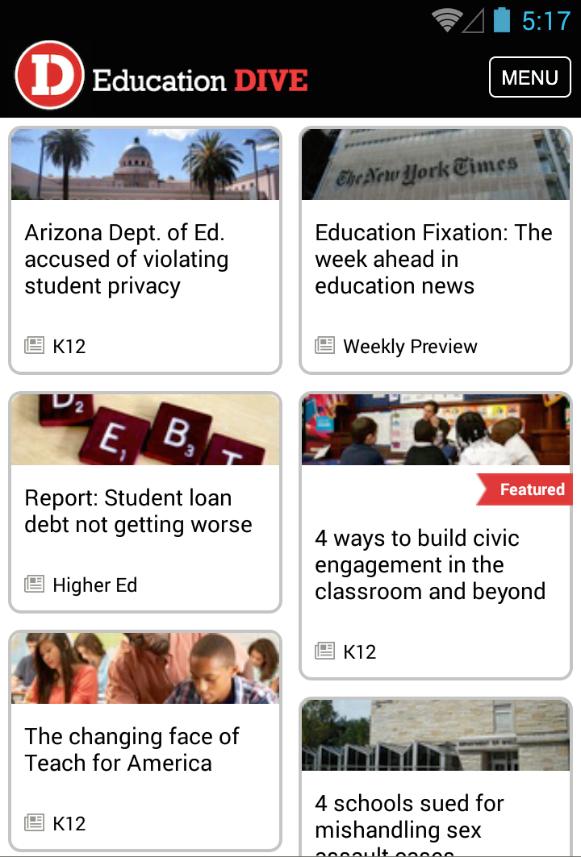
A recent article about a teacher in NJ:
Video-Based Questioning- A new technique for teaching through video clips.
A useful list of education conferences and events worldwide
http://www.educationdive.com/events/
A recent article about a teacher in NJ:
Video-Based Questioning- A new technique for teaching through video clips.
A useful list of education conferences and events worldwide
http://www.educationdive.com/events/
Friday, November 11, 2016
Teaching Through Tough Subjects: Slavery

In 5th grade in NJ, curricula includes the history of the United States from Native Americans to the Civil War. We cover "What is slavery?" In 2002, NJ also approved the Amistad Bill to ensure schools address and have tools to teach African American contributions to our nation's history.
Personally, I feel slavery is a very tough subject to teach. I'm sure many educators, especially in Elementary levels, feel the same. Though, the topic is an integral part of how our nation has evolved and a wide example of democracy, "we the people" working to be "a more perfect union." In fact, to not teach the subject is depriving students a full understanding of the American experience, a sentiment also expressed in the Amistad Commission. I challenge teachers to explore the subject but also how to approach teaching tough subjects to develop critical thinking and empathy.
Here are resources and ideas. I will add as I find more. Please comment to add to the list!
1. List of texts by grade level K-5: http://www.nj.gov/education/amistad/resources/literacy.pdf
2. Register as a NJ Educator on the Amistad Commission website: http://www.njamistadcurriculum.net/user/registration
3. African American Museum in Philadelphia has resource trunks to borrow and educational resources: http://www.aampmuseum.org/
4. Scholastic Articles:
-Teaching About Slavery in the Elementary Classroom
-African American Heritage
5. National Museum of African American History and Culture has educational resources: https://nmaahc.si.edu/
6. Smithsonian Resources: www.smithsonianeducation.org/educators/resource_library/african_american_resources.html
7. Tolerance.org Resources: http://www.tolerance.org/article/dos-and-donts-teaching-black-history
8. Resources from Teaching Channel on best practice techniques for social studies:
- https://www.teachingchannel.org/videos/teaching-slavery
- https://www.teachingchannel.org/videos/tch-presents-social-studies-essentials
Monday, October 31, 2016
Dramatic Teaching: Social Studies
You open your Kohl's coupon and it says 30% off. Do you cheer a little bit? Give students that same experience with this SS lesson.
Trade, Exploration, Conquistadors, and the Development of Colonial America
Two things are going on here in this lesson model. On one side I am teaching a grand, overarching idea: trade. At the same time, I am using theater to create an experience The driving force for the Silk Road and Columbus's journey can be acted out like this:
Provide a variety of country names for students to research.

Pairs or teams of students research what natural resources, goods, and services their country provides. They can use this list to make trading cards. As they work I ask them to consider making two of each, or more. They can use one to trade and keep one for their country. Make sure they write the country of origin, their team name, on their cards. It makes discussing imports and exports easier later.
Students meet in a circle and trade freely. Each country should have items to help their citizens survive: food, shelter, transportation, communication (technology). There are always some students that take the lead and their conflicts and resolutions make for great teaching points in the end.

Last, discuss what challenges students faced. How does that help understanding what it was like for nations as they developed the "New World"? You can stretch thinking to consider if these ideas still play a role in the way countries act in today's world. Or for higher levels, you can ask students to consider communism vs. capitalism, the fairness of trade agreements and embargoes, or connections to current events.
As students see the competition, they can feel and experience what drove human kind to reach out and explore the world around them, how a war might start, and how needs and wants drive our past and present. Besides all of that, it's just fun...just like scratching off that Kohl's coupon!
Trade, Exploration, Conquistadors, and the Development of Colonial America
Two things are going on here in this lesson model. On one side I am teaching a grand, overarching idea: trade. At the same time, I am using theater to create an experience The driving force for the Silk Road and Columbus's journey can be acted out like this:
Provide a variety of country names for students to research.

Pairs or teams of students research what natural resources, goods, and services their country provides. They can use this list to make trading cards. As they work I ask them to consider making two of each, or more. They can use one to trade and keep one for their country. Make sure they write the country of origin, their team name, on their cards. It makes discussing imports and exports easier later.
Students meet in a circle and trade freely. Each country should have items to help their citizens survive: food, shelter, transportation, communication (technology). There are always some students that take the lead and their conflicts and resolutions make for great teaching points in the end.
Last, discuss what challenges students faced. How does that help understanding what it was like for nations as they developed the "New World"? You can stretch thinking to consider if these ideas still play a role in the way countries act in today's world. Or for higher levels, you can ask students to consider communism vs. capitalism, the fairness of trade agreements and embargoes, or connections to current events.
As students see the competition, they can feel and experience what drove human kind to reach out and explore the world around them, how a war might start, and how needs and wants drive our past and present. Besides all of that, it's just fun...just like scratching off that Kohl's coupon!
Friday, October 28, 2016
4th Annual Conference on Reading and Writing
A great experience to see so many educational leaders in NJ! Lucy Calkins keynote!

Monday, October 24, 2016
Pro and Con Close Reading 2nd-8th

To provide students with ways to practice deep comprehension, close reading strategies for non-fiction texts, we buddy-read a selection. One student takes notes on a red sheet, paying attention to negative statements or ideas. The other uses a green sheet, recording positive statements.

Students help one another read and collect information, and they consider bias, pros and cons of events in history. Finally, pairs develop a debate "script" where they turn-key their section to the class in a performance. It could be two competing paragraphs or a back and forth dialogue.


This week we are reading the section on explorers. So, the essential question becomes "Is exploration a good thing for humankind?" Students will extend their thinking by asking what the world would be like without this age of exploration and trade. Transfer of knowledge and fun. Woohoo!
Monday, September 28, 2015
Apps for Tablet Notes and Quizzes
Tablets might be just what you need to get students to understand new ideas and collect the data you need!

Try Kahoot!
An online quiz with a presentation on a class shared screen. Students can use any device to log on and view material for each customized question.

Try Socrative
An online class quiz for formative assessment and teacher decisions.

Try Nearpod
A tablet presentation that coincides with shared screen information. All students see the same screen. Many options for quiz questions, interactive slides, and polls.
Try Kahoot!
An online quiz with a presentation on a class shared screen. Students can use any device to log on and view material for each customized question.
Try Socrative
An online class quiz for formative assessment and teacher decisions.
Try Nearpod
A tablet presentation that coincides with shared screen information. All students see the same screen. Many options for quiz questions, interactive slides, and polls.
Sunday, September 27, 2015
How to Tie An Assembly to Real Learning
We plan on taking pictures, uploading them, and having students curate their own poster to summarize the event!
Websites for Student Projects Online
Websites for Student Projects Online
Wednesday, September 2, 2015
Behavior Management with Classdojo.com
Wondering how to start the school year off with a solid behavior plan and data collection system with easy ways to communicate to parents and fun incentives for kids that are free and fun that is easy to modify as the year goes on and can focus on a wide variety of positive skills?
Phew. That was a lot, right? Well, try www.classdojo.com. We are using it with 5th gradersWe also found some awesome freebies that add to the experience here:
Student Introduction:
https://www.youtube.com/watch?v=KaeNSYJvrn0
Fun, Free Incentives:
https://www.teacherspayteachers.com/Product/Class-Dojo-QR-Code-Behavior-Rewards-840653
Summary Points Tracker:
https://www.teacherspayteachers.com/Product/Class-Dojo-Point-Tracker-Freebie-2003264
Phew. That was a lot, right? Well, try www.classdojo.com. We are using it with 5th gradersWe also found some awesome freebies that add to the experience here:
Student Introduction:
https://www.youtube.com/watch?v=KaeNSYJvrn0
Fun, Free Incentives:
https://www.teacherspayteachers.com/Product/Class-Dojo-QR-Code-Behavior-Rewards-840653
Summary Points Tracker:
https://www.teacherspayteachers.com/Product/Class-Dojo-Point-Tracker-Freebie-2003264
Monday, August 31, 2015
Brain Pop Be Poppin'

Brain Pop is like a safe, educational youtube for your classroom. I always check to see if there's a supplementary video for my lessons in Science and Social Studies. Also, I choose one for morning work or dismissal and let students take the quiz whole group style. But wait, there's more...
There are lots of great features such as:
1. Standards search to find videos for all subject areas in your state:
2. Teacher and student account for individualized assignments and testing: http://educators.brainpop.com/getting-started-mixer/
3. Teaching with games and even platforms for kid designed games:
http://educators.brainpop.com/whygames/
4. Brainpop Jr. for K-3 students
https://jr.brainpop.com/
5. Lesson plans and printables
http://educators.brainpop.com/teaching-resources-main-2/
4. Brainpop Jr. for K-3 students
https://jr.brainpop.com/
5. Lesson plans and printables
http://educators.brainpop.com/teaching-resources-main-2/
There's a lot to this service and if your school already has an account, there is a strong chance that you are not using all of the features that are available! Check it out!
Friday, August 14, 2015

Thursday, August 13, 2015
Google Certification Training
2 Day Google Training
www.Edpuzzle.com - Videos and engaging students.
www.Padlet.com - Class can post on one wall! Digital dashboard for today! Put vid, links, text, Use as an exit ticket.
www.Todaysmeet.com - A discussion board for anyone with the link for today! Add link to give to classroom and text dashboard.
www.Pixlr.com - free photoshop
www.Geoguesser.com - guess where you are game
https://sites.google.com/site/gtoolsedu/ How to use Google
https://edutrainingcenter.withgoogle.com/fundamentals/preview How to Use Google
Forms consist of 3 areas- 1. Form editor 2. Live form 3. Spreadsheets of responses
Form editor can be filled out to schedule teacher conferences!
GOOGLE CLASSROOM (an lms) (workflow management tool) (released in august-june, 70 million assignments) (co teacher!, drafts!, mobile apps!)
- only used with academic accounts in the school district
- classroom only exists with google apps for education
THURSDAY links-
https://www.remind.com Send a text to all kids and it hides phone numbers
Google Keep- notes
Tasks in Gmail- To do lists in gmail
http://www.symbaloo.com/ a note pad with symbols
www.Viewpure.com - this site strips videos of bad things and ads
http://www.movenote.com/ talk over documents or presentations, create video of presentation
www.Flippity.net - Use google drive (spreadsheets) Jeopardy template, random name picker, randomly assigned grouping of different amounts, progress shower, flashcards.

Here is a google doc opened in Drive.
- Highlight text (Ex: “Larry Page”)
- Click Tools (in top bar)
- Click Research
- Use functions in research bar: Citations, Maps, Images, etc.
- Scroll down to Websites. Use 3 options: preview, insert link, citation (as seen in pic)
ADDONS!!! Super cool ways to improve using Drive functionality
GOOGLE CITATION-
- Add ons (voice recorded feedback on page Kaizena, easy bib, rubric maker!)
Tuesday, July 14, 2015
Google Trends
It looks like this free tool on Google might lend itself to some amazing lessons on compare and contrast, data analysis, search, and literacy. I can't wait to try this with fifth graders this year!

Here's one I've set up:
https://www.google.com/trends/explore#q=%2Fm%2F01kmd4%2C%20%2Fm%2F01jz6d&geo=US&cmpt=q&tz=Etc%2FGMT%2B4
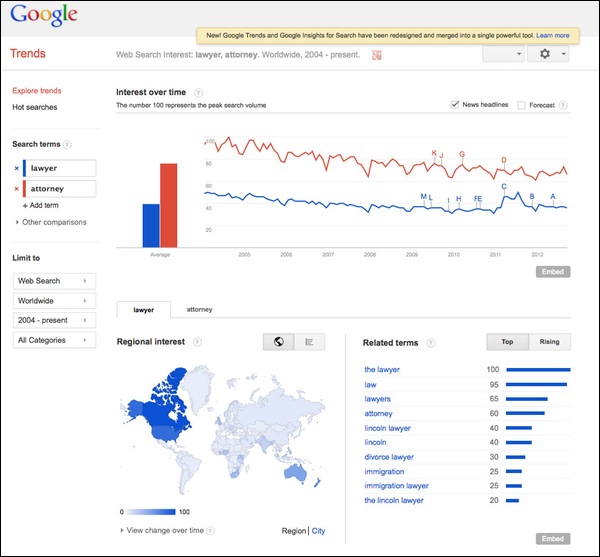
Here's one I've set up:
https://www.google.com/trends/explore#q=%2Fm%2F01kmd4%2C%20%2Fm%2F01jz6d&geo=US&cmpt=q&tz=Etc%2FGMT%2B4
Thursday, July 2, 2015
Monday, June 1, 2015
Monday, February 9, 2015
Students Lacking Motivation in Math?
Here's one math teacher's take on pitfalls of math education and ways to fix it.
Tuesday, January 27, 2015
Engage Your Students
http://www.ascd.org/publications/educational-leadership/sept14/vol72/num01/Motivated-to-Learn@-A-Conversation-with-Daniel-Pink.aspx
Do you want compliant students or engaged students? Here's an excerpt that was well done, so I figured I'd share. There's a subtle line between leadership and management. In light of the recent outcry against the PARCC test, the last paragraph is particularly insightful.
I don't have all the answers, but I'm looking for meaningful learning tasks on a daily basis, and providing autonomy, strategically, is one way to make that possible.
"In your book Drive, you wrote, "While complying can be an effective strategy for physical survival, it's a lousy one for personal fulfillment." Nevertheless, people spend a lot of time complying in school. What needs to change?
Do you want compliant students or engaged students? Here's an excerpt that was well done, so I figured I'd share. There's a subtle line between leadership and management. In light of the recent outcry against the PARCC test, the last paragraph is particularly insightful.
I don't have all the answers, but I'm looking for meaningful learning tasks on a daily basis, and providing autonomy, strategically, is one way to make that possible.
"In your book Drive, you wrote, "While complying can be an effective strategy for physical survival, it's a lousy one for personal fulfillment." Nevertheless, people spend a lot of time complying in school. What needs to change?
There's a huge difference between compliant behavior and engaged behavior. With compliant behavior, you're doing what someone told you to do the way they told you to do it. There's nothing wrong with that, but it's different from engagement. With engagement, you're doing something because you truly want to do it, because you see the virtues of doing it.
Now most good teachers don't want compliant students—they want engaged students. It's more fun to teach engaged students; it's kind of dreary to teach compliant ones. Human beings, whether they're 6-year-olds in a 1st grade classroom or 46-year-olds in a corporate boardroom, don't engage by being managed or controlled. We engage by getting someplace under our own steam.
So if we really want engagement rather than compliance, we have to increase the degree of autonomy that people have over what they do; over how, when, and where they do it; and over whom they do it with.
Students don't have a lot of autonomy in school—but neither do their teachers. Many trends in federal policy, especially over the last decade, have focused on constraining teacher autonomy. Now when I say that autonomy leads to engagement, it doesn't mean that you have to turn the autonomy dial up to 10 in every circumstance. If you really want to get people engaged, you have to find ways to increase autonomy the right amount at the right moment.
Now what does this mean in practice? It means not having a system that requires that every 3rd grade teacher everywhere in the country on the second day of March is teaching the exact same thing in the exact same way. That's a disaster.
What it means in terms of students is giving them some discretion over what they study, which projects they do, what they read, or when or how they do their work—just upping the autonomy a bit. We're not talking about a wild and wooly free-for-all where everyone does whatever they want whenever they want to do it.
What I am suggesting is that our default assumption, for both students and teachers, should be this: Let's trust people with autonomy instead of assuming they can't handle it.
But here's the challenge: At some level, compliance is a lot easier for the people at the very top of an education system. It's a lot more convenient if you have compliant teachers and compliant students. And management is all about getting compliance. Even if you sand off the rough edges and oil the gears, the technology of management is still designed to produce compliance.
We need something different—something beyond management, whatever the next iteration is. We need leaders, both in organizations and in schools, who create an atmosphere in which people have a sufficient degree of freedom; can move toward mastery on something that matters; and know why they're doing something, not just how to do it.
And this leads to another challenge, an uncomfortable question for legislators, governors, and presidents: Are our education policies designed for the convenience of adults or for the education of our children? Take high-stakes testing—it's easy, it's cheap, and you get a number, which makes it really convenient for adults, whether they're taxpayers or policymakers. But is heavy reliance on punitive standardized tests the best way to educate our children? Probably not. Doing what we truly need to do for our kids is going to end up being pretty inconvenient for a lot of adults. But to my mind, it's the only way to go." -Daniel Pink
Wednesday, January 21, 2015
Assess Your Literature
Is your class library reaching the needs of a diverse group of students?
http://www.adl.org/assets/pdf/education-outreach/Assessing-Children-s-Literature.pdf
http://www.adl.org/assets/pdf/education-outreach/Assessing-Children-s-Literature.pdf
Great Literature
A list of awards that recognize diversity in literature. Go to these awards for better choices for class reading.
http://libguides.lib.msu.edu/c.php?g=96613&p=626686
http://libguides.lib.msu.edu/c.php?g=96613&p=626686
Monday, December 1, 2014

Subscribe to:
Posts (Atom)